Thursday, 23 April 2009

Was Easter That Long Ago?

It seems like only yesterday!

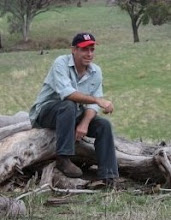
We went out to the block for a couple of days camping over Easter with my brother. It started out rainy, but by the time I'd erected the camp kitchen covering (of dubious utility in the end) the rain had eased off and it looked like we were going to have a great time of it.


It was great to get out there and not be thinking about working there, just to enjoy the place. We had a campfire on the Friday evening, and retired relatively early after a big day getting everything together.

On the Saturday morning we took a walk down the eastern gulley, discussing the geology of the region, and examining the rocks in the outcrops we came across. We found some nice specimens of sedimentary rocks that had been broken and reset during their lifetime, where the alternating bands of coloured stone had shifted in relation to one another. I'll remember to get a picture of some next time I'm out there so you can share in our excitement ;-)

After that little jaunt we set out for the creek. We'd brought the inflatible boats along so the lads could have a float about which they enjoyed for a while. They've got a bit of learning to do before they get paddling under control though!


After doing that for a while we wandered up the rocky hillside, then returned to camp as there was quite a storm brewing on the horizon. It set in after lunch, torrential rain like we would only expect whilst camping. DW packed the kids up and headed home, whilst brother and I resolved to brave the elements and camp onward.


The rain calmed down in the early evening, so we sparked up another fire and he cooked me up a camp stew. That and a couple of beers helped keep the chill at bay, and by bedtime there were hints of moonlight through the clouds, offering us the promise of a sunny dawn.

Sadly, that wasn't to be, with even darker clouds on the horizon the next morning. We madly packed up the site and set off home, resolving to choose better weather next time. All in all it was a great time, and it helped clear the head of all the issues surrounding the place. It's funny how spending time out there doing jobs prevents me from remembering the other reasons why we liked the place, just for the sheer beauty and peacefulness of it all. Being out there has reaffirmed that, and made me keen to get on with the project so we can live out there (sometime in the next 10 years ;-) )


To that end, I stopped procrastinating over designing the intersection for the laneway, finished drawing it up and had it submitted to council not long after Easter. Back to the waiting game again, but with a bit more enthusiasm than we've had in recent months.

April 30 (if all goes according to plan) sees the end of the fire danger season, which will mean we can camp out and have a fire whenever we choose, rather than needing to organise permits in advance. I think the odd weekend campout will do us all the world of good! I can do a couple of days (or half days) of work there, with a relaxing evening around the campfire to finish it off.

Photos courtesy of Mr M.C. used with kind permission!

Friday, 3 April 2009

Forged Iron Product Process

The diagram above presents a generic model for creating products. It's the same as pretty much any process diagram, in that it has inputs, processes, outputs (product) and a feedback loop. When looking at the overall household system, we can break each input to the household down into one of these models. The products of one model will form the inputs for another model and so on down the chain.

It's useful to consider things at this degree of detail for a couple of reasons. First and foremost it allows us to consider just how much hidden activity goes on out in the wider economy to supply what seem like simple goods into our households.

Below is a more complex diagram that details the major components of a model for any forged item. This covers a kitchen knife, a fork, spoon, fire poker, coat hook, gate latch etc. items commonly seen in our households.

As you can see there are a number of inputs, two of which could be considered "consumables", one other material item, "other tools" which covers things like hammers, anvil, tongs, swages etc. Then there is labour and skill. I have distinguished these two items because feedback has an important effect on them in particular.

As we undertake the process of forging, and examine and use the finished items, you provide yourself with feedback that goes toward the development of your skill. More skill equates to more productive and economical use of your labour. Feedback also affects the other items, both via the conduit of skill and directly. You may use less inputs next time around, or slightly different inputs, perhaps your charcoal wasn't as well made as it should have been, so your feedback from this process actually affects the production model for charcoal.

Labour and skill we provide from ourselves, but what of the other elements. The other tools might be forged or cast items in their own right. Of course they could be purchased, but we are considering the systems in totality, examining just how much we would need to do if we were to supply everything ourselves. Metal certainly deserves a more detailed analysis, but for this post we will simply accept that it can be either recycled or extracted via mining.

The final diagram for today is the product model for charcoal.

In it we can see that the basic process takes wood and a pyrolysis unit and produces charcoal and sundry other outputs. In a more detailed examination it would be worth considering what those other outputs are, as they would certainly be useful, but for today we only want to know that they exist. We're most interested in the charcoal.

This diagram differs from the previous ones, in that it includes two other product models within it. You have most likely already noticed that I've used the bluish colour to represent the entire model. So we see that wood is a product of a forestry or wood production process. The pyrolysis unit also is the product of another complete process. You can probably guess that both of these processes will contain a wide range of inputs, which are themselves the product of other processes. We now begin to see the depth of the systems that operate to provide us with the knife and fork I will soon be using to eat our evening meal.

In the next post following this theme I hope to draw some common processes out from the much larger mass that goes into the household system. These common processes will be selected due to the fact that they lie at a root level, or are fundamental to a large number of other production processes. Besides the sheer joy of the insights, this will also allow us to get a grasp of the fundamental skills and resources we need within a community in order to maximise resilience.

Tuesday, 31 March 2009

Letter To The Editor

Our local politician, John Cobb, is kind enough to supply us with a piece of his mind in the local rag "The Central Western Daily" and today's piece was all about the proposed "carbon taxes" and how they will affect exporters. I cannot find an online version of his piece, though his view is expressed at the end of the following article HERE.

Mr Cobb has expressed opposition to the scheme on the basis that it will decrease the competitiveness of Australian agricultural exporters in overseas markets as well as allowing increased access to Australian markets for foreign agricultural imports.

The actual piece in the "Federal View" section went on at great length about how agriculture was going to be affected economically by any plans to mitigate climate change. This continued economic focus is really starting to wear on me, so I penned the following missive and shot it off to the editor. I wonder if they will publish it...

Re: Tue March 31st 2009 - "Carbon tax a burden for exporters" CWD

I should first point out that Mr Rudd's plan is not a carbon tax, it is a cap and trade scheme. That Mr Cobb cannot distinguish between the two shows that he wasn't paying enough attention during the briefings, if indeed he attended them at all.

A carbon tax would be a much better approach to the problem, but given most politicians make their profits from the big end of town we certainly aren't going to see a real solution of that nature. Can we all say "coal industry stranglehold" in unison?

Our economy and our community is going to suffer greatly under the burden of climate change. This is accepted fact as far as the majority of scientists are concerned, the exception being generally the few who are well paid by various heavily polluting industries.

Agriculture, the industry singled out by Mr Cobb, is going to suffer more than any other due to climate change. Will working to preserve exports save the dairy farmers from endless drought? Logic would say not. Our farmers need more than such a spurious claim of support.

We either need to change the way we live, to accept that there are hard limits on our greed, and hard choices to be made, or we need to give up now, and enjoy the party while we can. We need to stop wasting time and money pretending to make plans that we're never going to bother with. An Earth Hour once a year is just not going to get the job done.

If we choose to think about the future we are leaving our children and grandchildren, then we need to tell these politicians that we care more about people than the economy. Yes, it will hurt, but the future is going to hurt a whole lot more if we don't do some hurting now. Are we adults going to bear a bit of hurt, or are we going to leave it to our children to bear it?

A bit of thought might allow our leaders to conclude that if we adopt stringent policies and place taxes on carbon emissions at home, then we should have the right to levy similar taxes on imports where the originating countries do not adhere to such policies. We also set the stage for a real world-wide legal argument over the future of our species, for the exporters in other countries will surely get a bit upset over those taxes.

If we place a large carbon tax on imports from countries that do not have such policies our exporters are protected, our local industries are encouraged, and we work to combat further climate change. We get three advantages where John Cobb is offering us one, and a dubious one at that.

Friday, 13 March 2009

What the EL?

Two posts in one week?! Something must be up :-)

Just this morning I had a call from a local mining company, who have the EL (Exploration Licence) on our new block of land. This wasn't totally news to me, our good neighbours had warned us that they'd been paid a visit not long back.

It was an interesting conversation, the crux of it being that they were going to be doing a special scan of our area some time this year, and if they found anything interesting they'd take it from there, perhaps with some exploratory drilling, and then negotiation to purchase what they needed if their drilling confirmed their scanning.

I informed them of the status of our plans for the block, and asked them if they could get in sooner rather than later. We'd much prefer find out that we have to move on sooner rather than later. I can imagine the disappointment I would feel after planting a few hundred trees to suddenly find the whole lot was scheduled to be bulldozed. He mentioned that he would mention it to TPTB, though I don't know how we'll fare having such things rescheduled to suit our insignificant plans.

All this time we've been asking for signs, looking for inspiration as to what to do, and then this comes along. Perhaps all the council slowdowns and hiccups have been for a good reason? Maybe we've been put off precisely because these folks want to dig the whole lot up, and so there was really no point to progress in the first place? If this exploration does uncover something, will the relevant content of this blog form a body of somewhat circumstantial evidence as to the existence of Universe-directed synchronicity that moves in a direction to make our lives better?

The DW and I have discussed it, and resolved that we'll take a slowly slowly approach for now. We'll proceed with the plans for the shed, even though that means doing some work for council at our expense, but we're not going to panic about getting our adventure up off the ground to a great extent until we find out what the mining guys want.

If nothing comes of their investigation we can proceed with greater surety. Their technology is pretty advanced being able to view down to 2km under certain conditions, to see what is under the ground. They reckon that if they don't see anything under the ground worth having, then there isn't anything under the ground worth having. If they do their scan this year then we can get back on track for the next one, and only be an extra year behind, yet still a bit ahead given that we should have the roads and shed sorted out. Given the way synchronicity has flowed on this whole endeavour, I'm placing a bet that they will find something, sad as that will be.

As an added bonus, I've hit them up for a look at our underground realms if they don't find anything. Having an interest in rocks and geology and bones of the earth sort of stuff being able to see what's down there will mollify me greatly, and will be like winning even if I don't win the bet. Maybe there are underground caves? Buried rivers? Long lost kingdoms?? lol!