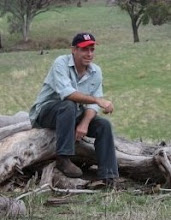
But not yet delivered!
Today saw the signing of the contract for the sale of our block of land. Ahead is the exchange and then the wait until we can settle. The interested party mentioned in the previous post came back to us after some time with a revised offer which was much closer to the mark. A polite and swift round of negotiation later and we were theoretically over the line. Less than a month later and we are two inky scrawls even closer.
Some time in the near future we're going to need to get out there and collect all the "resources" that I'd so lovingly gathered and carted and stored out there. I'd say some of it will go to the tip, but the majority of it is potentially useful, and can be used almost as well here as it could have been there. I'm hoping at least that I can bring the sawmill back, it's always been pleasing to me to know that I'm in possession of such a deadly implement, even if it's not hooked up to a power source...
The whole experience has certainly been a learning one. We've got a fair way to go to get back on track, but this is the first positive step in that direction, and it's exciting to finally be taking it. As much as we will miss the land, we wont miss the grief that went along with it.
Things have otherwise been trundling along, the new duck house I'm building is slowly progressing, and our bowls pairs game went well last weekend. This Sunday we will be in the semi-final, which is exciting for a novice. Hopefully I'll also get the duck house closer to completion as well.

Showing posts with label general. Show all posts
Showing posts with label general. Show all posts
Thursday, 26 May 2011


Monday, 15 December 2008
Weekend Report
Friday was full of rain, and boded poorly for the weekend ahead. We'd planned to go fishing at some stage over the weekend, but with the rain looking to be set in, we weren't sure when we would get the chance.
Saturday dawned clear of rain, though still cloudy with a bit of a biting wind. We decided we'd best get moving on the fishing plans, so set out to Lake Carcoar. After about an hour of driving we pulled in to find "no fishing" signs (hidden amongst the plethora of other things you aren't or shouldn't be doing out there). Sadly, as the lake is down at 14% or so of capacity there is a problem with toxic algae, so they've put a stop to fishing. All the lads had dropped off to sleep about 10 minutes before pulling in to the lake reserve, so we quickly settled on a trip to Lake Canobolas, which necessitated completing the round trip via Orange and out to that lake.
It worked out well in the end. The lake was fairly quiet in terms of visitors, most being turned off by the poor weather. The eldest son caught his very first fish, a redfin carp, with the gear he got for his birthday back in September. It's the first time we've had a chance to get out fishing since then, and I hope a catch will make him remember the experience with something other than dread.
After an hour or so we packed up the gear and walked over the top of the dam wall to the swings on the other side, and spent a while on a few trips down the flying fox (great fun, even for the big kids), and then headed off home again.
Sunday came up rainy again, so after congratulating ourselves on choosing to go fishing the day before, I got ready to head out to the new block to do up some measurements for the placement of the shed. Once we sign on the dotted line and get our engineering drawings back I'll need to be able to put in a DA, so need to know the best spot for it. Not sure if all of that will happen before Christmas at this rate, we keep getting stalled by different things. As always, such stallings are sure to work out for the best, so we're not too concerned, though we are keen.
I was back home by midday, and spent a bit of clear weather making the kids a tarzan rope swing, and clearing out some of the dodgy stuff in the greenhouse and potting a few bits and pieces on into larger pots. We've got a fair idea now of what hasn't taken from the winter cuttings, so we'll have to start a summer cuttings round very soon.
In the garden we've had an amazing abundance of fruit this year. We've been eating berries and currants for weeks now, and we've still got a lot to go. I guess we'll have to get started on some jam making soon. All the primitive plums are loaded, ripe and ready to go. Our first Japanese plums are showing a good amount of colour, and should be softening soon. The peaches, well, the birds are starting to sample those, so hopefully there'll be some left for us when they're ripe, as they're still pretty green at the moment.
On the selling front, we're holding off on going to the real market for now, interest rates have declined enough that we will be able to put money into the new block and pay for the usual stuff, though I guess it's risky if we hit a period of inflation due to declines all round in the economic world. At this point it's a wait and see approach, at least until after the silly season.
As of next week I get my annual (sort of) holidays, so hopefully three weeks of relative bliss. In case I don't post before then, I wish you a merry festive season, and all the best for the year ahead. Things are going to be challenging all round, which should make for interesting times...
Saturday dawned clear of rain, though still cloudy with a bit of a biting wind. We decided we'd best get moving on the fishing plans, so set out to Lake Carcoar. After about an hour of driving we pulled in to find "no fishing" signs (hidden amongst the plethora of other things you aren't or shouldn't be doing out there). Sadly, as the lake is down at 14% or so of capacity there is a problem with toxic algae, so they've put a stop to fishing. All the lads had dropped off to sleep about 10 minutes before pulling in to the lake reserve, so we quickly settled on a trip to Lake Canobolas, which necessitated completing the round trip via Orange and out to that lake.
It worked out well in the end. The lake was fairly quiet in terms of visitors, most being turned off by the poor weather. The eldest son caught his very first fish, a redfin carp, with the gear he got for his birthday back in September. It's the first time we've had a chance to get out fishing since then, and I hope a catch will make him remember the experience with something other than dread.
After an hour or so we packed up the gear and walked over the top of the dam wall to the swings on the other side, and spent a while on a few trips down the flying fox (great fun, even for the big kids), and then headed off home again.
Sunday came up rainy again, so after congratulating ourselves on choosing to go fishing the day before, I got ready to head out to the new block to do up some measurements for the placement of the shed. Once we sign on the dotted line and get our engineering drawings back I'll need to be able to put in a DA, so need to know the best spot for it. Not sure if all of that will happen before Christmas at this rate, we keep getting stalled by different things. As always, such stallings are sure to work out for the best, so we're not too concerned, though we are keen.
I was back home by midday, and spent a bit of clear weather making the kids a tarzan rope swing, and clearing out some of the dodgy stuff in the greenhouse and potting a few bits and pieces on into larger pots. We've got a fair idea now of what hasn't taken from the winter cuttings, so we'll have to start a summer cuttings round very soon.
In the garden we've had an amazing abundance of fruit this year. We've been eating berries and currants for weeks now, and we've still got a lot to go. I guess we'll have to get started on some jam making soon. All the primitive plums are loaded, ripe and ready to go. Our first Japanese plums are showing a good amount of colour, and should be softening soon. The peaches, well, the birds are starting to sample those, so hopefully there'll be some left for us when they're ripe, as they're still pretty green at the moment.
On the selling front, we're holding off on going to the real market for now, interest rates have declined enough that we will be able to put money into the new block and pay for the usual stuff, though I guess it's risky if we hit a period of inflation due to declines all round in the economic world. At this point it's a wait and see approach, at least until after the silly season.
As of next week I get my annual (sort of) holidays, so hopefully three weeks of relative bliss. In case I don't post before then, I wish you a merry festive season, and all the best for the year ahead. Things are going to be challenging all round, which should make for interesting times...
Wednesday, 13 August 2008
Ashes to Ashes
In The Garden
Green with a gun has suggested using the ashes on the garden. I have until now avoided this, recalling warnings we were given when first starting out in gardening that it would alter the pH of the soil and damage it's structure. In the interests of finding the facts and deciding whether we really do have a winning solution I thought it worth investigating some more.
Research across a range of sources reveals the following elements may be present in wood ash, with quantities being dependent on the wood burned, and the ground that the tree grew in. In all cases hardwood ashes have more nutrients (and more ash) than softwood ashes. The values below are all from Northern hemisphere sources, and there's a chance our local Eucalyptus would come up with slightly different numbers.
Green with a gun has suggested using the ashes on the garden. I have until now avoided this, recalling warnings we were given when first starting out in gardening that it would alter the pH of the soil and damage it's structure. In the interests of finding the facts and deciding whether we really do have a winning solution I thought it worth investigating some more.
Research across a range of sources reveals the following elements may be present in wood ash, with quantities being dependent on the wood burned, and the ground that the tree grew in. In all cases hardwood ashes have more nutrients (and more ash) than softwood ashes. The values below are all from Northern hemisphere sources, and there's a chance our local Eucalyptus would come up with slightly different numbers.
| Element | Content | Notes |
|---|---|---|
| Calcium | 15% - 30% | Generally in the form of calcium carbonate. This is the same stuff we get in lime, which is used to raise soil pH from acid towards alkaline. |
| Potassium | 3% - 9% | In the form of potash |
| Phosphorus | 1% - 3% | As phosphates. |
| Magnesium | 1% - 3% |
|
| Sulphur | 0% - 1% |
|
| Boron | Trace | A number of the trace elements are often classed as “heavy metals” and considered to be pollutants rather than valuable nutrients. |
According to the PDF:
wood ashes are 40% - 50% as effective at altering soil pH when compared to lime. The other sources indicate that the constituents of ashes are water soluble therefore fast acting, in contrast to lime which takes longer to do it's job.
All sources indicated that wood ash should only be used on alkaline soils, and if using large amounts pH should be tested every year or two.
A number of other warnings were supplied, paraphrased, condensed and/or summarised below:
- Don't use ash at the same time as applying nitrogenous fertilisers. The fertilisers will gas off the nitrogen as ammonia in the high pH, so you're wasting resources. Wait for a couple of weeks for the ash to do it's thing then apply the nitrogen.
- Acid loving plants should not have wood ash applied to them e.g. Blueberries.
- Alkaline should not have ash applied to them, and neutral soils should only have it applied very carefully in small quantities.
- Ashes should not be applied where potatoes will be put as they may promote potato scab.
- Don't use ash from stuff other than wood. You never know what you'll get.
- Don't use ash on your seedbed at time of planting or on seedlings, ash salts are quick acting and relatively strong, so will burn the seedlings.
Another use for wood ash is as a pest control. It can be liberally dusted over infestations of pear and cherry slug to great effect. It was the solution of choice applied during my childhood, and I recall with some trepidation the act of spreading the stuff around.
Some representative sources on wood ash in the garden:
Wood ashes from your yule log can help your garden grow
Use caution with wood ash on your lawn and garden
WOOD ASHES - How To Use Them In The Garden
Is Wood Ash Good for Garden Soil?
In Soap and Fuels
Wood ashes (from hardwood trees) can also be used to make lye. Lye is generally made by soaking water through a barrel (with a perforated base) of ashes. The stuff that comes out the bottom is lye water, and needs to be concentrated for use by boiling off the excess water. This is pottassium hydroxide, rather than sodium hydroxide. This is good news if you're looking for a complete on-farm process for making biodiesel, as pottassium hydroxide is the stuff that is used to make ethanol-ester biodiesel, and ethanol can also be made on-farm, unlike methyl-ester biodiesel (which uses sodium hydroxide) See the following if you want to know more:
A comprehensive guide with pictures covering soap making from lye is available at:
Another blog indicates that soap from potash lye is a jelly or soft soap, and requires hardening up with the addition of table salt if that is the aimed for product. According to the resource hard soaps are made with sodium lye.
Wednesday, 25 June 2008
Misappropriated Revolution?
I finished reading a book called “The Owner-Built Homestead” by Barbara and Ken Kern last night, originally published in1977, though it indicates the original copyright year was 1974. The book has languished on my shelf for a number of years now, being referred to sporadically and in a piecemeal fashion. With our new project in it's formative stages I've dusted off a number of books like this and read them cover to cover to make sure I don't miss anything useful.
Last night, as I read the final chapter I came across the following gem that caused me some concern. Please forgive any transcription errors, and unconscious changes of spelling to my native tongue:
Homesteading is a self-reliant way of life on the land, and wholesome food production may well be the first step toward achieving self-reliance. This momentum toward self-reliance and self-provision has been, in recent years, appropriately labeled the Green Revolution. It has been quietly moving forward as families return to the soil to raise their crops and their children. Nothing seems substantially to impede it's progress.
I've enboldened the shocking bit. All through the recent years of my life I've known the Green Revolution according to the standard of the day, that it referred to the scientific conquest over nature. As I drifted off to sleep I thought about this change. It's quite common for different groups to use the one term in different ways, but these two uses of the term seem to be diametrically opposed. One refers to a shift of lifestyle back closer to the earth, the other to a shift in practices that facilitate a movement of people away from the land, and a gradual destruction of the earth.
A quick search of the internet seems to indicate that the first use of the term “Green Revolution” in it's modern context is ascribed to USAID director William Gaud in 1968. To quote answers.com:
The term "Green Revolution" was first used in 1968 by former USAID director William Gaud, who noted the spread of the new technologies and said, "These and other developments in the field of agriculture contain the makings of a new revolution. It is not a violent Red Revolution like that of the Soviets, nor is it a White Revolution like that of the Shah of Iran. I call it the Green Revolution."
Speech by William S. Gaud to the Society for International Development. 1968.
http://www.answers.com/topic/green-revolution?cat=technology
The full text of the speech is available at:
http://www.agbioworld.org/biotech-info/topics/borlaug/borlaug-green.html
So it would appear that William's use of the term predates it's inclusion in the book by at least 6 and maybe 9 years, though I imagine greater research would perhaps dig up references to the term in a lot of old homesteading literature from those times.
No matter which way it went, whether it was the chicken or the egg, the science based revolution gained the association with the term, for better (and in my opinion) or worse. Reading through the speech, the following sticks out, and I wonder what impact such a statement has had:
Is the aid program in trouble because economic development does not matter - because it is not important? Nonsense! Development is the burning obsession of more than half the people in the world. Development as Pope Paul has said, is the new name for peace. Development does matter and it cannot wait.
Pope Paul said that development is the new peace? Development that now works for the rich and fails the poor? The following from http://www.indiastudychannel.com/resources/16170-Origin-Green-Revolution.aspx sums it up nicely:
Yet far from bringing prosperity, two decades of Green Revolution have left Punjab riddled with discontent and violence. Instead of plenty, Punjab has been left with diseased soils, pest infested cops, waterlogged deserts. indebted and discontented farmers.
It has often being suggested that the Green Revolution was the only alternative by which India and the rest of the Third World could have increased their food availability. Yet, until the 1960's India was successfully following an agricultural development policy based on strenghthening the ecological base of agriculture and the self-reliance of peasants. Most of the states were undergoing land reforms and measures were taken to secure tenure for tenant cultivators, to fix reasonable rents, and tjo abolish the Zamindari system. Ceilings on land holdings were also reduced. The 'land transformation' programme put forward by the Ministry of Agriculture, achieved major successes. Infact, the rate of growth of total crop production was higher during this period.
I don't want to “buy a vowel”, I want a consonant. And that consonant would be the letter “d” and we can replace our “n” and get a much better picture. We know how powerful words and phrases can be, that the pen is mightier than the sword. If only the Green Revolution as we now know it had been correctly labelled as the “Greed Revolution” and left the subsistence movement with the name “Green Revolution” where might we be today?
To finish with another quote from Barbara and Ken, speaking on the Green Revolution:
As one unsung poet puts it, “Don't look for it's soldiers in the city. Most of the real ones are long since gone to their domesand gardens, with goats and chickens the day was won. You will now see only plastic imitations who will starve yelling, “What's it all mean?” - not knowing that the revolution has come and gone and was won in a patch of beans.”Obviously the closing years of that decade was one of hope for sane and rational living.Unfortunately what was seen as a shift gaining momentum appeared to lose that forward drive during the 1980's and 1990's, floundering against the renewed vigour of capitalism and corporate agribusiness.
The movement is still there, but it still remains a subset of society, a fringe group, probably similar in proportion to what it was when Barbara and Ken wrote that book. The trouble is that we are now faced with greater and more pressing concerns, such as climate change and peak oil, and the apparatus of government and business that has congealed around society is operating to the direct detriment of the homesteading movement (whatever it may be called in people's own societies). These concerns were there back in the 1970's, but they were neglected in the intervening years, so the danger they present has increased dramatically, and our chances of taking action, and of that action producing useful results, have been proportionally reduced.
Here in Australia we face numerous challenges on our path to becoming small farmers, and that's before we even get to the stage of thinking about sticking something in the ground or on the field. Sometimes it seems that the powers that be have done everything possible to make self-reliance a difficult and demanding path to follow. It is likely that this is an unintended side-effect of the push to make things easier for big centralised corporations, but it has it's effect regardless of the ultimate motive.
Reclaiming the Green Revolution is probably beyond us now, and as it was such a catchy, pithy phrase, it is a great shame. All the same, the self-reliance revolution must go on. Perhaps it will be the Golden Revolution, powered by the sun, ushering in a golden age of harmony with the earth?
Friday, 30 May 2008
Another Quick Update
Yet another month flown by! I wont bother making excuses for not posting, they're the same as the usual ones ;-)
I've calmed down since my water crisis, and essentially given up on the idea of having a lot of massive dams, at least for the moment. We've decided we'll have a single large dam to the capacity of our maximum harvestable right, situated at the bottom of hill, where three gullies feed into one. It's a nice spot for a dam.
The rest of our water needs we will handle through swales/contour banks. This will help prevent erosion on our very steep block, as well as ensuring any water that does fall takes the long way round on it's journey to the creek. If we can maximise the work it does then we'll be as well off as if we stored it in the first place.
We're still tossing up a lot of ideas for cropping, nothing has been settled yet. Having our water plans sorted out (sort of) allows us to make some more serious decisions, at least with respect to dumping some ideas. We wont be growing a commercial crop of hazelnuts for one, though we may still have a crack at some olives.
We're also toying with the idea of a bit of herbage. The DW really loves herbs, and so do I, so I think they'd be perfect given our inclinations. We will of course have to do a lot of market research before we move in that direction, but it allows an avenue of diversity. One of our axioms for this adventure is "not all of our eggs in one basket".
Part of our building process involves putting in a 5m or bigger stock grid on the council road (it's not theirs yet, and they may be sent the bill for it before they can have it, lol!) and we've been covered a lot of suppliers for prices. Thankfully we found a relatively local supplier who has them for half the price we've been quoted to date, so that is a bit of good news. I just hope we can take advantage of it before steel prices shoot through the roof.
Our other option is of course to convince the landowner on the other side of the council road that it is more economical to fence his paddock off, even though he loses a scrap of grazing land (that belongs to council anyway). This option is half the price of the lowest priced grids.
The new farm is generally on hold until we get the current farmlet officially on the market (it's sort of on there now, but not properly). We're working through the painting, and have finished off the tiling, so it's slowly getting there. One of the major hurdles will be when we want to move all our accumulated resources out to the new place. Storage there is currently nil, so we're going to need to implement some solutions for that. We have contemplated containers, and may end up going that route, they're almost as economical as a shed (floorspace per dollar wise) without the construction headaches.
So many up in the air plans can get confusing and cause an undue amount of stress. Thankfully it's the weekend now and we're planning a campfire out the back tonight (in fact I think it's already lit!). Sausages, coleslaw and fire-taters, with toasted marshmallows for desert. A great way to wind down from the working week before getting into the working (but infinitely more satisfying) weekend.
I've calmed down since my water crisis, and essentially given up on the idea of having a lot of massive dams, at least for the moment. We've decided we'll have a single large dam to the capacity of our maximum harvestable right, situated at the bottom of hill, where three gullies feed into one. It's a nice spot for a dam.
The rest of our water needs we will handle through swales/contour banks. This will help prevent erosion on our very steep block, as well as ensuring any water that does fall takes the long way round on it's journey to the creek. If we can maximise the work it does then we'll be as well off as if we stored it in the first place.
We're still tossing up a lot of ideas for cropping, nothing has been settled yet. Having our water plans sorted out (sort of) allows us to make some more serious decisions, at least with respect to dumping some ideas. We wont be growing a commercial crop of hazelnuts for one, though we may still have a crack at some olives.
We're also toying with the idea of a bit of herbage. The DW really loves herbs, and so do I, so I think they'd be perfect given our inclinations. We will of course have to do a lot of market research before we move in that direction, but it allows an avenue of diversity. One of our axioms for this adventure is "not all of our eggs in one basket".
Part of our building process involves putting in a 5m or bigger stock grid on the council road (it's not theirs yet, and they may be sent the bill for it before they can have it, lol!) and we've been covered a lot of suppliers for prices. Thankfully we found a relatively local supplier who has them for half the price we've been quoted to date, so that is a bit of good news. I just hope we can take advantage of it before steel prices shoot through the roof.
Our other option is of course to convince the landowner on the other side of the council road that it is more economical to fence his paddock off, even though he loses a scrap of grazing land (that belongs to council anyway). This option is half the price of the lowest priced grids.
The new farm is generally on hold until we get the current farmlet officially on the market (it's sort of on there now, but not properly). We're working through the painting, and have finished off the tiling, so it's slowly getting there. One of the major hurdles will be when we want to move all our accumulated resources out to the new place. Storage there is currently nil, so we're going to need to implement some solutions for that. We have contemplated containers, and may end up going that route, they're almost as economical as a shed (floorspace per dollar wise) without the construction headaches.
So many up in the air plans can get confusing and cause an undue amount of stress. Thankfully it's the weekend now and we're planning a campfire out the back tonight (in fact I think it's already lit!). Sausages, coleslaw and fire-taters, with toasted marshmallows for desert. A great way to wind down from the working week before getting into the working (but infinitely more satisfying) weekend.
Thursday, 24 April 2008
Ooops
I'd like to apologise to anyone who still stops by to see if anything has changed! It's been an awfully long time since I put up a post.
A lot has happened in the months since the end of January. A lot is still happening, so this is just a short note to let you know I still exist, and will attempt to resume something like normal service soon.
We have our new block of land, and have been getting it ready to have some animals agisted on it. We've also got the repayments on it, and interest rates have gone from 7.8% to 8.5% in the few months from November last year. Amazing stuff!
We've got our current liferaft (the Flood Street Farmlet of course) informally on the market now. I say informally as it's not being put with any agents at the moment, and is offered at reduced cost as we haven't finished things like painting, tiling etc so it doesn't look as good as it will shortly. Still, if somebody wants it now they're welcome to it :-)
It seems things are heating up across the world with respect to peak oil, peak everything, and the general crisis of civilisation. Some recent blogs by folks far more dedicated than I can hope to be at the moment. Of course they also have a lot of very intelligent and scary things to say!
http://thearchdruidreport.blogspot.com/2008/04/business-as-usual.html
And, if you're getting the feeling that you're in the midst of history in the making:
http://sharonastyk.com/2008/04/22/we-regret-to-inform-you/
Take care, and I promise to write something a bit more substantial soon!!
A lot has happened in the months since the end of January. A lot is still happening, so this is just a short note to let you know I still exist, and will attempt to resume something like normal service soon.
We have our new block of land, and have been getting it ready to have some animals agisted on it. We've also got the repayments on it, and interest rates have gone from 7.8% to 8.5% in the few months from November last year. Amazing stuff!
We've got our current liferaft (the Flood Street Farmlet of course) informally on the market now. I say informally as it's not being put with any agents at the moment, and is offered at reduced cost as we haven't finished things like painting, tiling etc so it doesn't look as good as it will shortly. Still, if somebody wants it now they're welcome to it :-)
It seems things are heating up across the world with respect to peak oil, peak everything, and the general crisis of civilisation. Some recent blogs by folks far more dedicated than I can hope to be at the moment. Of course they also have a lot of very intelligent and scary things to say!
http://thearchdruidreport.blogspot.com/2008/04/business-as-usual.html
And, if you're getting the feeling that you're in the midst of history in the making:
http://sharonastyk.com/2008/04/22/we-regret-to-inform-you/
Take care, and I promise to write something a bit more substantial soon!!
Friday, 30 March 2007
The Map is Not (Quite) the Terrain
 If your eyes are strained clicking the plan above will open a larger one, hopefully in a new window. North is actually to the bottom of the page, East is to the left...
So what is it you're looking at? The short answer is four years of growth from a bare patch used for motorbike riding and infested with miniature horses.
The grey box up in the top right corner is the house, around it mixed gardens of ornamentals and herbs, along with a few specimen trees. We're on a hillside, the front of the place, to the right, is the lowest point, the top left corner the highest.
 Below the house is the sheep yard, well, at the moment it is. Two lambs are slowly fattening toward roasthood in the dappled shade of some box elder and myrobalan plum trees. We've put in a mighty oak, hoping it will feed off the septic leach field and grow big and strong, but it suffered the ignoble fate of becoming sheep fodder. Thankfully it's slowly returning to it's former glory, all two foot of it that it had.
Moving to the left we travel through the vegetable patch, which gave us a fair serve of tomatoes and heaps of chillies this year, despite the drought (more correctly "thanks to the bore") though very few zucchinis in comparison to previous years.

The bottom of the map, the North fence, is home to a row of tall gums, which whilst majestic, serve to suck the life from a good portion of that area, as well as casting an inconvenient shade over prime growing land. We've elected to put in a laneway up the side of the block to accommodate them.
All the coloured green circles are the fruit trees in the orchard. The block of nine trees and the triangle slightly to the left is our first two years of effort, three apples, five peaches and an almond tree, two Japanese plums, a Valencia orange and a quince. The sharp sighted will notice two extra blobs in the triangle. The rest of the trees to the left, plus these two blobs, all arrived last winter, and with the exception of a pear, all have survived the drought, again thanks to the bore.
In addition to a few more 'normal' apples last years additions included some authentic apple cider apples possessing great names such as 'Foxwhelp' and 'Brown Snout'. A prune, pear, seedling walnut and hazelnuts of various sorts rounded out the locally obtained products.
 After poor results obtaining locally any of the more unusual varieties of tree we were after we were able to get hold of a few on our list, a Coe's Golden Drop, a Sloe, and and a Greengage, shipped all the way up from Tasmania, thanks to the marvellous Bob Magnus They were a late order and the season was well under way by they time they arrived but have done very well considering. This year we've planned ahead and already put our order in, so our trees should arrive in early winter, rather than mid spring.
The blue blobs are our pond and intermittent 'stream' i.e. it runs when I need to fill the pond and feel like running the hose up that far. One day we hope to get some form of renewable energy device to power a pump to circulate the water for us, but that's way down the list of 'wants', we don't even have tanks yet, which would almost qualify as a 'need'.
Still on blobs (blobs on blogs, very Dr Seuss) the grey blobs above the pond and orchard is our quarry. We are blessed with an abundance of exposed basalt outcrops, along with a great deal of not-so-exposed boulders strategically positioned in all the places we hope to stick a fork or spade. The mattock and bar are our most used and abused gardening tools.
 Right next to the pond is the red square that marks the greeny-blue coloured chookhouse. We've got a permanent high-security run that they are always allowed in, night and day, and then one day-run, in which they are allowed to browse occasionally. The plan is to create at least another one of these and rotate between them. We currently have some Dorkings, and one each of Barnevelder and Spangled Hamburg hens.
The rooster is a bit rowdy, they haven't been allowed out into the main yard since he chased one of the younger sons across the orchard last year. It's one of those memories that son will carry with him forever. There have been calls for a culling over the issue, but so far I've been able to resist them.
Out of 6 chooks we're lucky to get an egg a day, so we suspect we've got an egg eating chook. The plan is to rig up a mobile ark and cycle the chooks into it in small groups to see if we can catch the culprit.
 To the right of the chookhouse is the berry patch and vineyard, though it only possesses two grape vines so far. An abundance of raspberries, and currants make up the bulk at the moment, though our three blueberry bushes are doing well, and the youngberries are coming along nicely enough considering conditions. The currants are interplanted with strawberries, and we have a single row of coloured perennial cotton that we're trying out. It's done well enough, but once the frosts arrive I doubt it will be so perennial. We've got enough seed now to put in a bigger crop next year in any case.
Just above the berry patch is a brown box, our borrowed glasshouse, that was almost finished last weekend. There is perhaps enough of a tale in that to make a post of it's own, so I'll save it for later torment. Our ducks, Khaki Campbells, live in the little blue box just to the left of the glasshouse. In reality it's marginally more comfortable than it looks on paper, but only just. It used to be the chook run, and was destined to be a potting shed before we discovered how swiftly ducklings can grow. One day they may move to more suitable quarters up near the pond.
 The only place left to describe is the top left section of the map, above the blobs that are the rocky outcrops. Our aim, once we have done some earthworks to help retain soil and moisture up there, is to plant it out to wild timber and bigger trees, to provide shelter from southerly winds. There are currently two olive trees and a black walnut up there. I've read that olives are suited to rocky hillsides, so I'm going to test them out. I also had a cork oak but it didn't make it through the early part of summer, so I'll have to try again with that.
There used to be a seed company many years ago (well not that many, maybe ten or fifteen years) that sold a great selection of tree seeds, including all sorts of oaks. If anyone knows of something similar, please let me know!
Monday, 26 March 2007
The Three W's

What, Where, Why
The Flood Street Farmlet is a single acre (just slightly less to be entirely honest) of hillside to the west of the Great Dividing Range in New South Wales. It contains a number of fruit trees, chooks, ducks, guinea pigs, two lambs and three children. It is the nucleus for a future larger version along the same lines.
Whilst the kids are young we felt it better to stay in a village and work on a smaller scale. As they get older they'll be capable of doing some useful work rather than requiring time and effort for maintenance! This place allows us to learn, try new things, and most importantly collect together a nucleus of plants, animals, tools and materials ready for the next place (if time and conditions grant us the opportunity to move on).
The picture above is from upstairs, looking east, almost a year after we had moved in. The little shed is our first chook house. Development proceeded from a dusty miniature horse ridden paddock to it's current state, with an orchard of 30+ trees, berry patch, and vegetable garden.
We moved to this place after a stint in the city, both of us had spent time in the country as youngsters, and longed to move back. That's not the whole reason for the shift though. Whilst country living is certainly superior (in our opinion) to city living, there were a number of more pressing reasons for making the move.
In a nutshell, the state of the world causes us great concern. Modern society is rushing toward the final crisis, the collective collision of scarcities in energy, food, security and wellbeing. People are always prognosticating on the end of the world as we know it, and others are always having a laugh at them. I tend not to laugh at things when the evidence points in favour of the need for a more serious appraisal of the situation.
This blog is aimed at chronicling our quest toward a greater level of independence and quality of life. Now that the three W's have been answered, we are left with the H, the how of it all. You might see some of that here as time progresses. The Why will surely be revisited as time goes by, as the events that we anticipate unfold around us.

Subscribe to:
Posts (Atom)


 Posts
Posts